
Last Updated: 28 May, 2026
The SEE 2082 Compulsory Science exam was held on Chaitra 23, 2082 (April 6, 2026) across all seven provinces under subject code RE-1041. The paper carries 75 written marks over 3 hours, with a separate 25 mark practical assessment bringing the total to 100. Unlike most subjects, Science tests three distinct disciplines in a single paper, physics, chemistry, and biology along with environmental science, which makes it one of the more demanding papers in the SEE schedule. Province specific codes were used: Bagmati (RE-1041’BP’), Koshi (RE-1041’KoP’), Gandaki (RE-1041’GP’), Lumbini (RE-1041’LP’), Karnali (RE-1041’KaP’), Madhesh (RE-1041’MP’), and Sudurpashchim (RE-1041’SP’).
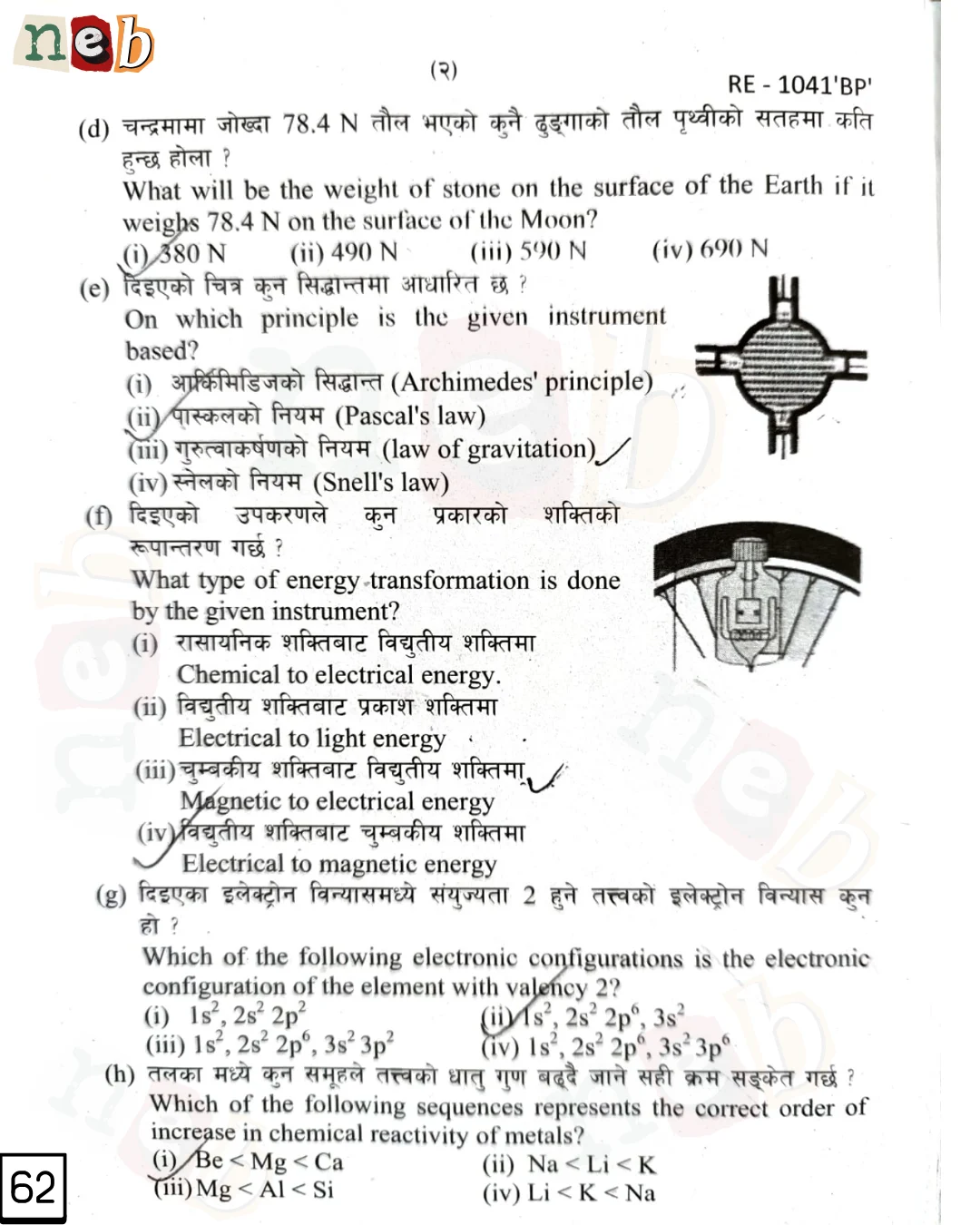
Below are the collected question paper images from the SEE 2082 Science exam.




Download SEE 2082 Science Question Paper PDF
Download the full paper in PDF and keep it for revision whenever needed.
More Helpful Resources
Once results are out, check your GPA using our SEE GPA calculator or read the NEB grading system guide to see exactly where your grades fall on the official scale.
Share Your Questions
Sat for this exam? Send any questions you remember to nebgpacalculator@gmail.com. We credit every contributor by name, and the questions you share go directly into preparation material for next year’s Class 10 students.
FAQ about SEE Compulsory Math
When was the SEE 2082 Compulsory Science exam held?
It was conducted on Chaitra 23, 2082 (April 6, 2026), four days into the SEE 2082 examination schedule.
What is the subject code for SEE Compulsory Science 2082?
The base code is RE-1041. Each province appended its own identifier, Bagmati used RE-1041’BP’, Koshi used RE-1041’KoP’, and so on but all papers followed the same syllabus and structure.
How is the SEE Science paper structured?
The written exam is 75 marks over 3 hours. Questions span physics, chemistry, biology, and environmental science in a mix of objective, short-answer, and long-answer formats. A separate 25-mark practical is assessed at the school level.
Which topics carry the most weight in the SEE Science paper?
Physics and biology typically account for the largest share of marks. Common high weight topics include electricity, the human body, chemical reactions, optics, and ecosystem based questions.
Is the Science question paper the same across all provinces?
The structure and syllabus are identical, but the specific questions differ by province. Students from Koshi and Bagmati, for instance, received different sets under the same RE-1041 code.
How do I calculate my GPA after the Science result?
Use our SEE GPA calculator, enter your written and practical marks separately and it converts them into GPA based on the NEB grading scale.


